


Best Drugstore Vitamin C Serums for Women Over 40
This post contains affiliate links. If you buy through them, I may earn a small commission — at no extra cost to you.
Here’s a truth nobody tells you when you hit your 40s: your skin isn’t just “aging.” It’s going through a biochemical restructuring that makes your 30s skincare routine about as effective as using a paper towel to fix a leaky pipe. In the first five years after menopause, women lose up to 30% of their skin collagen. Not gradually, not gracefully — gone. That’s why your skin looks thinner, why that dark spot from your beach vacation three summers ago is suddenly very much still here, and why your complexion has gone from glowing to what I can only describe as “February in Cleveland.”
I’ve been using vitamin C every single morning for three years. It’s the one step I don’t skip, don’t negotiate with myself about, and have never regretted. It’s the reason I can run to the farmer’s market on Saturday without makeup and not feel like I owe anyone an apology. And my current bottle costs $18.
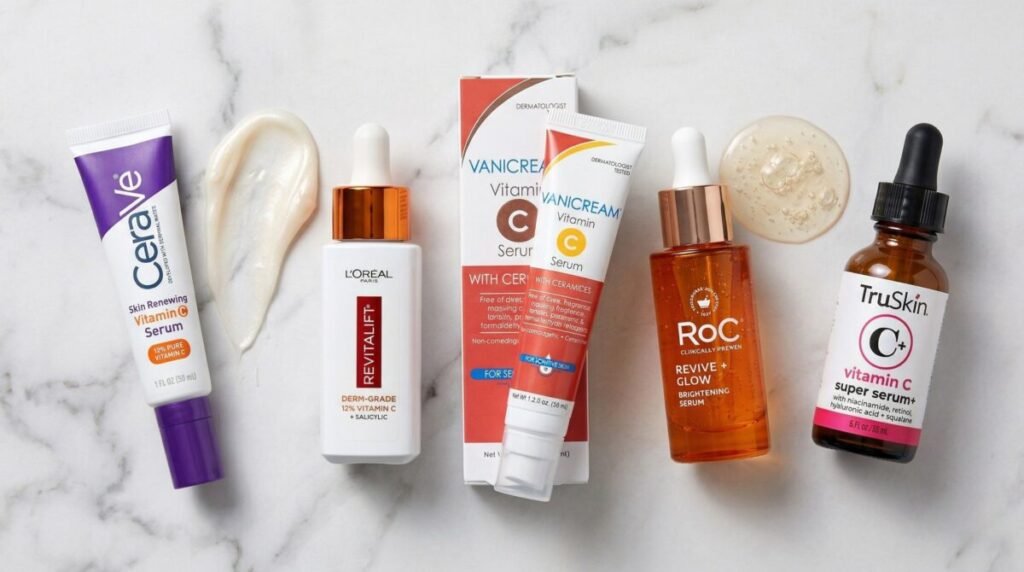
You don’t need a $150 serum. What you need is the right formula for your skin type, properly stored, applied in the right order. Brands like CeraVe, L’Oréal Paris, Neutrogena, RoC, Vanicream, and TruSkin are putting out clinically effective vitamin C at under $30 — and some of them are genuinely excellent.
Here’s everything you need to know to pick one and actually use it.
What Vitamin C Actually Does (and Why It Matters After 40)
This isn’t about chasing 25-year-old skin. It’s about giving your skin what it needs to function well at the stage it’s actually in.
The Collagen Connection
Collagen is the structural protein that keeps your skin firm, smooth, and bouncy. When estrogen drops during perimenopause and menopause, the enzymes that build new collagen slow down dramatically. Vitamin C is an essential cofactor for the two enzymes responsible for stabilizing collagen molecules so they form correctly. Without enough of it, collagen fibers form wrong and break down faster — which shows up on your face as sagging, deepening lines, and that papery quality that no amount of moisturizer seems to fix.
Topical application gets vitamin C directly to the cells that need it most, supporting your skin’s ability to build new, structurally sound collagen over time. It’s not magic. It’s chemistry.
The Antioxidant Gap
Aging skin produces fewer of its own antioxidant enzymes, leaving it dramatically more vulnerable to free radical damage from UV exposure, pollution, and yes, the blue light from the screen you’re reading this on. Vitamin C donates electrons to neutralize free radicals before they can damage your skin’s DNA, lipids, and proteins. It also regenerates vitamin E after it’s been depleted — which is why the best drugstore formulas pair both vitamins together. For anyone over 40 who has accumulated decades of sun exposure, this ongoing protection isn’t a bonus feature. It’s the whole point.
The Melanin Problem
Dark spots don’t just appear out of nowhere. They’re the result of years of UV exposure colliding with hormonal shifts in melanin regulation that happen after 40. Vitamin C inhibits tyrosinase, the key enzyme in melanin production, which slows the formation of new spots while gradually fading the ones you already have. This is also the benefit you’ll see first, which makes it deeply satisfying — most women notice brightening within one to two weeks, and meaningful spot fading around the six to eight week mark.
Signs Your Skin Is Basically Begging for Vitamin C
Persistent Dullness
Your skin looks flat and gray regardless of how much water you drink or sleep you get. That’s slowed cell turnover and oxidative buildup sitting on the surface like a confused houseguest who won’t leave. Vitamin C speeds up cell renewal and clears that buildup. Most women see a visible glow difference within the first week or two.
Dark Spots and Uneven Tone
New sunspots or patches of melasma that aren’t fading on their own, the way blemishes might have disappeared overnight when you were 28. Those don’t self-correct anymore. Topical vitamin C addresses this at the source, interfering with melanin synthesis rather than just concealing the result.
Fine Lines and Loss of Firmness
Deepening lines around the eyes and mouth, plus visible looseness in the cheeks or jawline, indicate declining collagen density. No topical product replaces lost volume the way a filler would, but consistent vitamin C use supports new collagen production and can genuinely soften fine lines over the 10 to 12 week mark.
Skin That Looks Thin or Fragile
Translucent, papery skin that irritates easily is a classic sign of reduced estrogen-driven thickness. Post-menopausal skin also holds significantly less vitamin C naturally, making topical replenishment not just helpful but arguably essential. Formulas that pair vitamin C with ceramides or hyaluronic acid address both the active aging concern and the hydration deficit in one step — which is a genuinely good deal at drugstore prices.
What “Clinically Proven” Actually Means on a Drugstore Label
The FDA classifies vitamin C in skincare as a cosmetic, not a drug. That means brands don’t have to prove efficacy before putting “clinically tested” or “dermatologist recommended” on the front of the bottle. I’ve learned this the expensive, disappointing way. The actual science supports topical vitamin C for collagen stimulation, photoprotection, and hyperpigmentation reduction — but the product in your hand needs to have the right concentration, the right form, and the right packaging to deliver on that research. More on packaging in a moment.
Look for concentrations of 10% or higher. Studies showing measurable improvements in firmness, brightness, and tone evenness used formulas in the 10 to 20% range applied consistently. Consistently. Daily. That’s the non-negotiable part.
Choosing the Right Formula for Your Skin Type
This is where most people go wrong. Picking the wrong form of vitamin C for your skin type is the fastest route to a serum that stings, sits untouched in your cabinet, and gets blamed for “not working.”
Not all vitamin C is the same. L-ascorbic acid is the gold standard — it has the most research behind it — but it’s also the most unstable and the most likely to irritate thinning, reactive, post-menopausal skin. Stable derivatives like THD ascorbate, ethyl ascorbic acid, and sodium ascorbyl phosphate work at a skin-friendly pH, are significantly gentler, and still deliver measurable results. For sensitive skin over 40, they’re often the smarter choice.
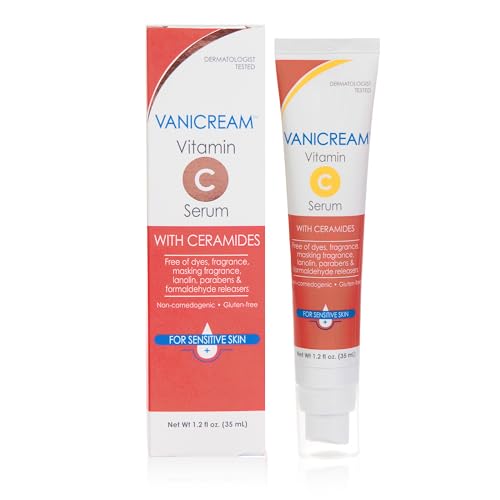
Dry or Post-Menopausal Skin: Vanicream Vitamin C Serum
THD ascorbate — a lipid-soluble derivative — penetrates more deeply than water-soluble forms and feels nourishing rather than drying. Vanicream’s formula uses exactly that, in a fragrance-free, airless pump that protects the vitamin C from oxidizing before you finish the bottle. Under $20, no nonsense, and genuinely good for skin that’s running on empty in the moisture department.
Vanicream Vitamin C Serum | Amazon
Sensitive or Reactive Skin: CeraVe Skin Renewing Vitamin C Serum
Ten percent L-ascorbic acid plus ceramides and hyaluronic acid. CeraVe designed this specifically to strengthen the skin barrier while delivering antioxidant benefits, which makes it one of the most thoughtful entry points for reactive skin. The ceramides aren’t an afterthought — they’re doing real work for skin that’s thinned with age. If you’ve tried vitamin C before and found it too harsh, start here.
CeraVe Skin Renewing Vitamin C Serum | Amazon
Normal to Combination Skin: L’Oréal Paris Revitalift 12% Pure Vitamin C Serum
Twelve percent L-ascorbic acid in a lightweight formula that absorbs without a greasy finish. L’Oréal has done actual clinical testing on this one showing measurable improvement in skin radiance and fine lines with consistent use. It layers beautifully under moisturizer and makeup without pilling. This is what I’d hand a friend who’s never used vitamin C and wants to start somewhere solid.
L’Oréal Paris Revitalift 12% Pure Vitamin C Serum | Amazon
Oily or Acne-Prone Skin: TruSkin Vitamin C Super Serum
If your skin runs oily and you want to consolidate your routine, TruSkin combines vitamin C with niacinamide, retinol, hyaluronic acid, and squalane in one serum. The niacinamide balances sebum production while the vitamin C brightens — it’s a logical pairing for skin that needs glow without extra congestion. One product doing several jobs, which I respect.
TruSkin Vitamin C Super Serum | Amazon
Targeting Stubborn Dark Spots: RoC Multi Correxion Revive & Glow Daily Serum
For melasma or deep-set age spots, you want a higher concentration paired with additional brightening agents. RoC’s formula is backed by a clinical study showing improved luminosity and skin tightness in just four weeks. If hyperpigmentation is your primary concern, this is the one to reach for.
RoC Multi Correxion Revive & Glow Daily Serum | Amazon
Packaging Matters More Than You Think
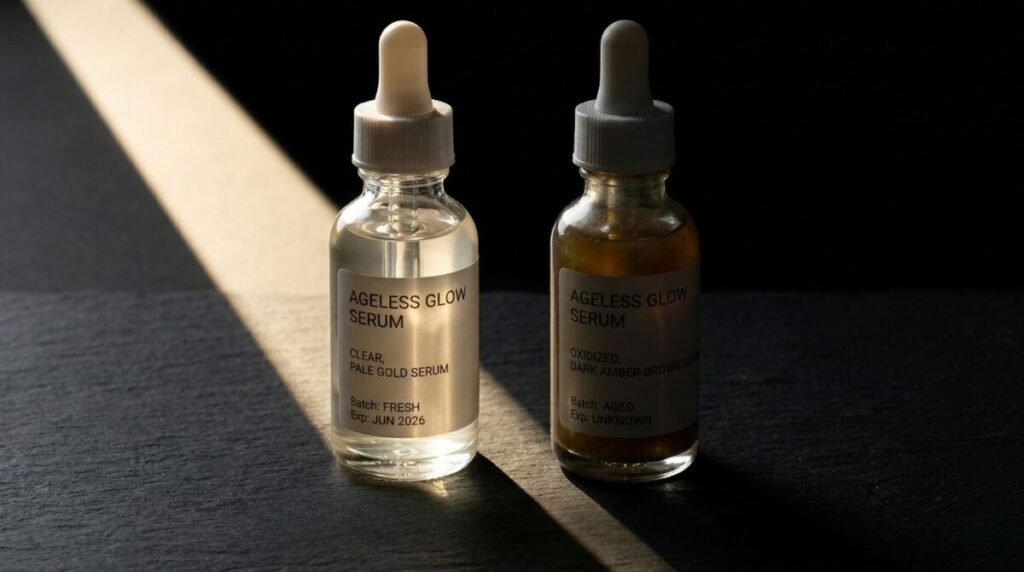
Oxidized vitamin C is essentially inert. You might as well apply tap water. The two main causes of oxidation are light and air exposure, which means clear plastic bottles and wide-mouth jars are already working against you before you’ve used a single drop.
Look for airless pumps, dark glass, or opaque bottles. If your serum has shifted from pale yellow to deep orange or brown, it’s oxidized — toss it. It won’t hurt you, but it won’t do anything useful either. Hopefully you’ve almost made it to the bottom of the container before this happens.
Storage tip: a drawer next to your sink, away from the shower’s steam and the window’s light. Boring location, dramatically extended shelf life.
How to Use It: My Morning Routine
Three years of daily use has refined this down to something I could do half-asleep, which is often exactly how I’m doing it.
Step 1: Cleanse. Gentle, pH-balanced cleanser. No harsh sulfates in the morning — they strip the barrier and increase sensitivity to actives.
Step 2: Pat dry, then wait. Slightly dry skin before you apply L-ascorbic acid formulas. Applying to damp skin dilutes the product and dramatically increases the chance of stinging.
Step 3: Apply three to five drops of vitamin C serum. Press it in gently rather than rubbing. Wait 60 to 90 seconds before layering anything else. Skipping this wait time reduces absorption and effectiveness. Set a timer the first few times until it becomes instinct.
Step 4: Layer supporting actives. Niacinamide, a peptide serum, or hyaluronic acid go on next, thinnest to thickest. The old advice warning against using vitamin C and niacinamide together is outdated — modern pH-balanced formulas are designed to work in tandem.
Step 5: Moisturize. Ceramide-rich moisturizer locks everything in and supports the barrier that thinning post-menopausal skin desperately needs. Vitamin C doesn’t moisturize — it needs to be sealed in.
Step 6: SPF 30 or higher. This step is not optional. Without daily sun protection, vitamin C’s brightening and anti-aging benefits are running uphill into a headwind. Your vitamin C investment is working; don’t let UV exposure quietly undo it.

What to Expect and When
Brightening and a visible glow: one to two weeks of consistent use. Dark spot fading: six to eight weeks. Firming and line-softening improvements: ten to twelve weeks. That last one requires the most patience, but it’s real and it compounds over time.
Consistency matters infinitely more than perfection here. The woman who uses her $18 drugstore serum every single morning for three months is going to see dramatically better results than the one who splurges on the $150 bottle, uses it occasionally, and lets the rest oxidize on her vanity. Your skin doesn’t care what you paid. It cares whether you showed up.
Start every other day if you’re new to vitamin C or have sensitive skin. Build to daily use over two weeks. If you experience persistent stinging or redness that doesn’t resolve, switch to a different formula rather than pushing through — that’s your skin telling you something useful. And once you find one you like, stick with it.
You’ve got this.

Discover more from The Harpy Nest
Subscribe to get the latest posts sent to your email.