
My Nighttime Skincare Routine – The Long Version
This post contains affiliate links. If you buy through them, I may earn a small commission — at no extra cost to you.
I spent a solid decade going to bed with sunscreen still on my face. Not always. But enough. I’d be tired, or it was late, or I’d already done the thing where I mentally called it a night while still sitting on the couch, and by the time I actually got to the bathroom, washing my face felt like one step too many. So I’d splash some water, maybe use a wipe, and call it skincare.
Here’s what I know now that I didn’t know then: you don’t need a 45-minute wellness experience to take care of your skin after 40. You need a routine you’ll actually do. Some nights that’s 15 minutes with full attention. Some nights it’s 4 minutes on autopilot because you’re exhausted and the dog is being weird and you just need to be horizontal. Both count. Both are fine. The only thing that doesn’t work is skipping it entirely and then skipping it again and then suddenly it’s been two weeks and your face feels like the Sahara in August.
Five steps. Same order every time. This is mine.
Why Nighttime Is When Your Skin Actually Does the Work
This isn’t a sales pitch for more products. It’s just biology worth knowing.
Cell turnover peaks between roughly 11pm and 4am. Cortisol, the stress hormone that actively suppresses cellular repair during the day, drops sharply when you sleep, which means your skin becomes more receptive to the actives you’ve applied and more capable of doing its own repair work. What you put on your face at night hits differently than the same products would in the morning. That’s not marketing copy. That’s your circadian rhythm doing something useful.
For skin over 40, there’s another layer. Estrogen decline, gradual for some, much less gradual during perimenopause, directly affects collagen synthesis, skin thickness, and barrier function. This skin isn’t just drier. It’s structurally different: thinner, slower to heal, more reactive, quicker to throw a fit when you use something too aggressive. The approach that works is barrier-first, then treatment. You support the skin’s own repair process rather than trying to bully it into compliance.

The Routine
Step 1: Cleanse — Non-Negotiable, Even When You’re Tired
Especially when you’re tired, honestly, because that’s when you’re most likely to skip it.
Night cleansing matters because your face spends all day accumulating SPF residue, makeup, pollution, and oxidative buildup, all of which interfere with the cellular repair your skin is trying to do while you sleep. A water splash is not a cleanse. A makeup wipe is not a cleanse. They’re optimistic gestures.
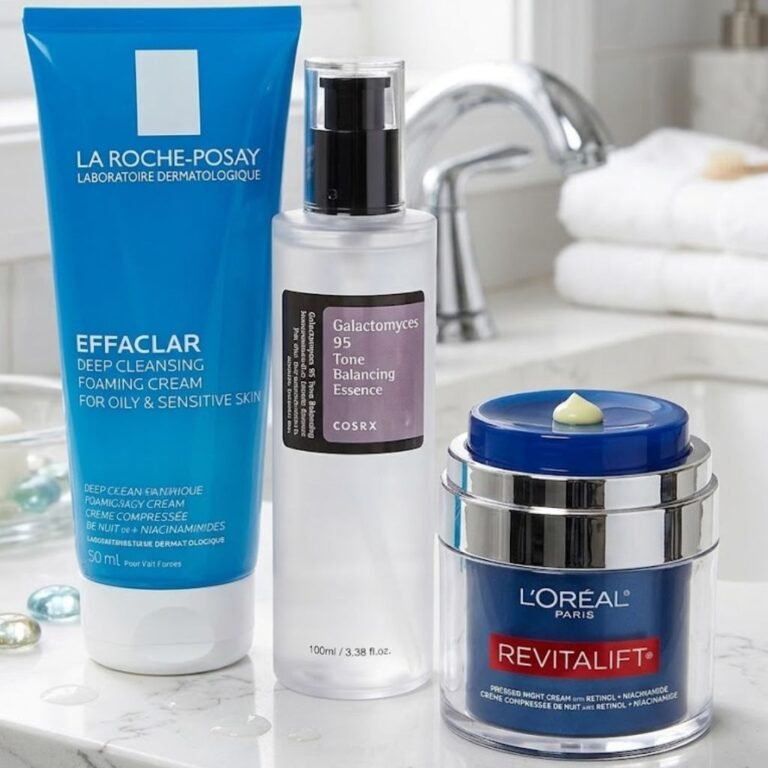
What you need is something that actually clears without wrecking the barrier, because stripping your skin to squeak-clean is not the win it felt like in your 20s. The La Roche-Posay Effaclar Deep Cleansing Foaming Facial Cleanser hits the right target, it clears congestion and lifts the day’s debris without leaving your skin feeling tight, reactive, or like it just went through something traumatic. For skin that’s simultaneously sensitive and prone to congestion (yes, both, perimenopause is full of these delightful contradictions), this is the one I keep coming back to.
Warm water, not hot. Fingertips in slow circles. Two minutes, or one minute, or however long you have. The point is contact.
La Roche-Posay Effaclar Deep Cleansing Foaming Facial Cleanser | Amazon
Step 2: Toner — Not the Kind From 1994
If the word “toner” makes you nervous, I understand. The toners of our youth were basically aggressive drying agents with a slight scent of punishment. You were right to avoid them. These are not those.
The COSRX Galactomyces 95 Tone Balancing Toner is what a toner actually should be: lightweight, fast-absorbing, and doing something real. Galactomyces ferment filtrate has solid evidence behind it for uneven tone, texture, and radiance, which is exactly what skin looks like after years of sun exposure and hormonal shifts start doing their thing. It absorbs immediately and preps everything underneath for what comes next.
Skip the cotton pad. Pour a small amount into your palms and press it in. No swiping, no dragging, no pulling on skin that’s thinned over time. Pressing activates warmth and gets better absorption. This step looks like nothing and does more than you’d expect.
COSRX Galactomyces 95 Tone Balancing Toner | Amazon
Step 3: Serum — Where the Real Work Happens
I get asked a lot if this product is worth the money, and I wish I could say it wasn’t, but it would be a lie. It is worth the investment.
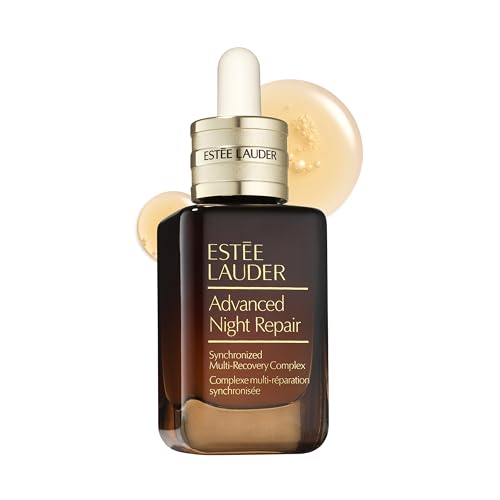
Serums penetrate. That’s the whole point. Smaller molecular weight, higher concentration of actives, formulated to reach the layers where actual change is possible. For nighttime use on mature skin, you want something addressing what’s already underway: collagen synthesis, barrier support, hydration that goes deeper than the surface. The Estée Lauder Advanced Night Repair Face Serum has been in my routine long enough that I’ve gone through six bottles, which is either an endorsement or a confession, probably both.
Hyaluronic acid works at multiple skin depths for hydration. Peptides support collagen synthesis. The formula is built around the skin’s circadian repair cycle. The chronobiology research is real, and this serum was early to take it seriously. Three drops, pressed into damp skin. That last part matters: hyaluronic acid applied to dry skin pulls moisture from deeper layers rather than the air, which defeats the purpose entirely. Damp skin. Every time.
Estée Lauder Advanced Night Repair Face Serum | Amazon
Step 4: Eye Cream — Different Skin, Different Rules
The skin around your eyes is thinner than the skin on the rest of your face. Fewer oil glands, less subcutaneous fat, more delicate collagen architecture, and it moves constantly, blinking, squinting, every expression you’ve ever made. It ages differently and it needs a formulation built for its specific behavior, not a hopeful thin layer of whatever face moisturizer you’re already using.
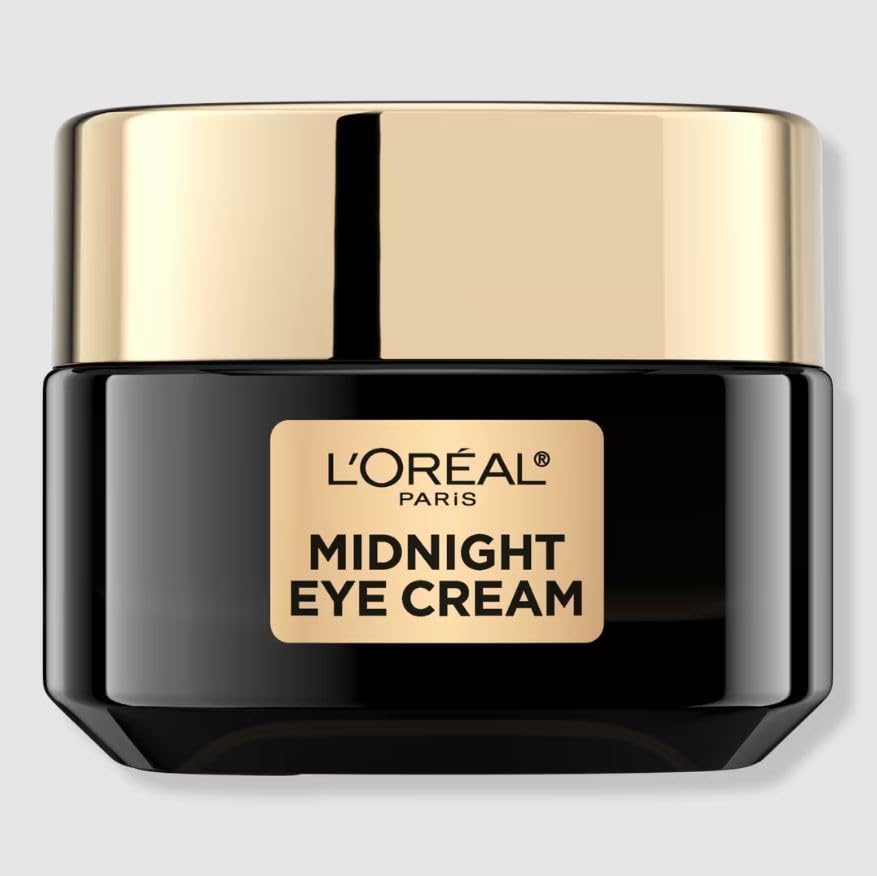
The L’Oréal Paris Age Perfect Cell Renewal Midnight Eye Cream is one I come back to without hesitation. Partly because the cellular renewal and firming formula does what it says, partly because the price point means I actually use enough of it. Using too little eye cream is a more common problem than anyone admits, and it’s usually a price problem.
Ring finger only. The ring finger applies the least pressure, which matters around the eye where repeated tugging does cumulative damage over time. Tap around the orbital bone rather than dragging. The product migrates on its own. You don’t need to work right up to the lashline, but it’s perfectly okay if you do.
L’Oréal Paris Age Perfect Cell Renewal Midnight Eye Cream | Amazon
Step 5: Night Cream — Seal It, Let It Work
This step is the one I do not skip, even on the nights when I’ve already skipped everything else. If I do nothing else besides wash my face, I do this one. That’s how important it is.
A good night cream isn’t competing with your serum, it’s completing the job. It seals in the actives underneath, supports barrier function, and gives your skin the sustained moisture it needs to run six hours of repair work. The L’Oréal Paris Revitalift Pressed Night Cream has a texture that earns its name: dense enough to create a real seal without sitting on top of your skin like a paste. The formula includes retinol at a concentration that’s genuinely effective without being aggressive. Which is the exact calibration mature skin needs. Too much retinol without enough moisture and barrier support is how you end up red, peeling, and swearing off the whole category.
The retinol does the treatment work while the cream does the barrier work. They’re running simultaneously. You’re asleep. It’s a good system.
On nights when I’ve only done this step and the cleanse, my skin still shows up for me in the morning. That’s not an accident. The pressed cream is the non-negotiable anchor of the whole routine. The minimum viable skincare, as it were, and it’s more than enough to keep things moving in the right direction.
L’Oréal Paris Revitalift Pressed Night Cream | Amazon
→ A natural next read: The Sunday Night Ritual That Changed My Relationship With My Face
What Actually Makes This Work
It’s not the products. The products help, they’re good products and I’ve explained why, but the products aren’t the mechanism.
The mechanism is doing it again tomorrow night.
Some nights this routine takes me 15 to 20 minutes and I enjoy every step. Some nights it takes me four minutes because I’m exhausted and running entirely on fumes and the only reason I’m doing it at all is because I’ve done it enough times that it’s easier to do it than not to. Both nights count equally. The skin that looked good in month four didn’t get that way because every single night was a considered, intentional wellness moment. It got that way because I stopped skipping two weeks in a row.
Skip a night? Come back the next night. That’s the whole strategy. Consistency over perfection, always, and the bar for “consistent enough” is lower than you’re probably setting it.
Wash your face. Use the pressed cream. If you have three more minutes, do the rest. Start there and build from it or don’t build from it. Either way, your skin is better off than it was when you were going to bed with sunscreen still on.
SHOP THIS ROUTINE



Discover more from The Harpy Nest
Subscribe to get the latest posts sent to your email.