
Skin Cancer Vigilance Isn’t Scary — It’s the Most Badass Thing You Can Do for Your Skin
This post contains affiliate links. If you buy through them, I may earn a small commission — at no extra cost to you.
One in five Americans will develop skin cancer by age 70. If that statistic made your stomach drop, I understand — but here’s the one that should replace it: when melanoma is caught early, the survival rate is 99%.
That second number is the whole point. Skin cancer signs over 40 aren’t a reason to spiral; they’re a reason to pay attention. And paying attention to your body — knowing it, reading it, advocating for it — is something you’ve been doing your entire adult life. This is just an extension of that. The women who do monthly skin checks aren’t the scared ones. They’re the ones who caught things at Stage I. They’re the ones who had options.
You’ve built a skincare routine. You read ingredient lists. You know your skin better than anyone else does. What follows is how to use that knowledge like the weapon it actually is.
What Actually Changes in Your Skin After 40 (And What Doesn’t)
Here’s what the medical pamphlets bury in the fifth paragraph: UV damage doesn’t show up on a schedule. The sun exposure you logged in your twenties and thirties is still in the process of manifesting. Skin keeps its receipts.
Add perimenopause to the picture and you get an accelerant. Falling estrogen levels affect melanocyte activity — the cells responsible for pigmentation — which means you may notice new spots, uneven tone, or shifts in existing marks that have nothing to do with sun damage at all. Estrogen also slows cell turnover, which means abnormal cells stick around longer.
→ If this resonates, you might like: Perimenopause Skin — The Peri Paradox
The result is a skin landscape that’s genuinely changing in midlife, which makes literacy more important, not more anxiety-producing.
For the record, here’s what’s usually normal: flat tan or brown spots with smooth, well-defined edges (solar lentigines, commonly called age spots), rough, slightly raised growths that look almost stuck onto the skin (seborrheic keratoses — these can look alarming but are benign), and small red cherry angiomas. These are common, especially in women noticing mole changes after 40, and they’re worth knowing by name so you can stop catastrophizing every new freckle.
What warrants professional attention is different — and that’s exactly what the next section covers. Skin cancer symptoms in women over 40 don’t always look like a textbook photograph. That’s why you need a framework.
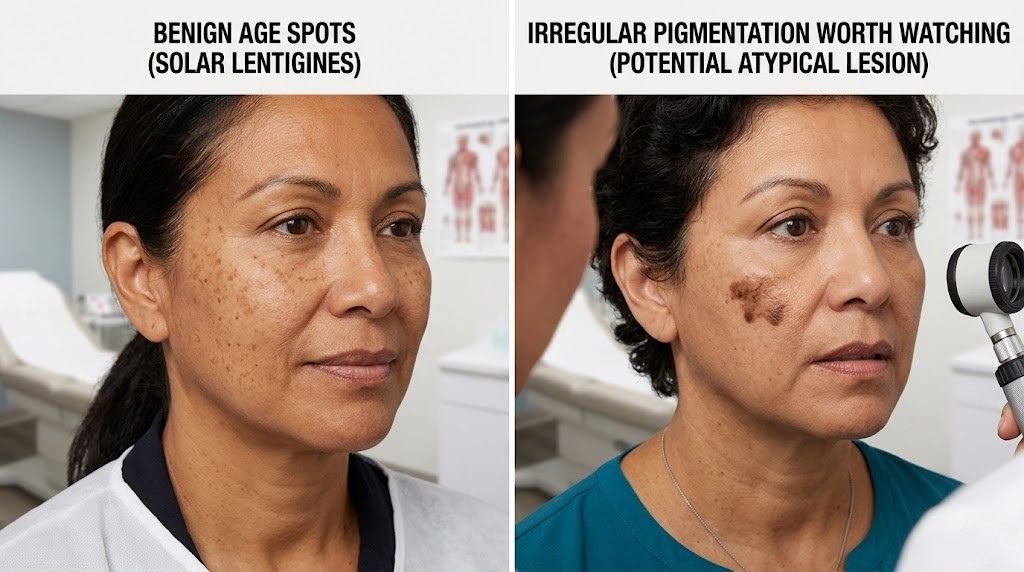
The ABCDE Framework — What You’re Actually Looking For
This is the clinical standard, and it’s useful — not because it turns you into your own dermatologist, but because it gives you a language for what you’re seeing. When you call your derm, you want to be able to say “asymmetric, two colors, grown in the last three months” rather than “it looks weird.”
Asymmetry. Draw a line through the middle. If the two halves don’t match, that’s a flag.
Border. A well-behaved mole has clean, smooth edges. Ragged, notched, or blurred borders are worth noting.
Color. One consistent shade — any shade of brown or tan — is normal. Multiple colors in a single spot (brown, black, red, white, or blue) are not.
Diameter. Larger than a pencil eraser (6mm) is the traditional threshold, though smaller spots can still be malignant. Size alone isn’t the whole story.
Evolution. This is the criterion that matters most when you’re thinking about when to worry about mole changes after 40. A spot that is changing — in any dimension, at any speed — deserves eyes on it.
The “E” Is the One You Can’t Skip
A textbook-ugly mole that has looked exactly the same for twenty years is much less concerning than a regular-looking spot that was different last month. Evolution is the tell. This is why photographing your skin matters — not obsessively, just consistently. Your phone camera and a free folder in your photos app are all you need. Same lighting, same day each month, same spots. If you’re squinting at a mark and genuinely can’t tell if it’s changed, your derm will thank you for having a baseline to compare.
How to Do a Monthly Skin Check You’ll Actually Do
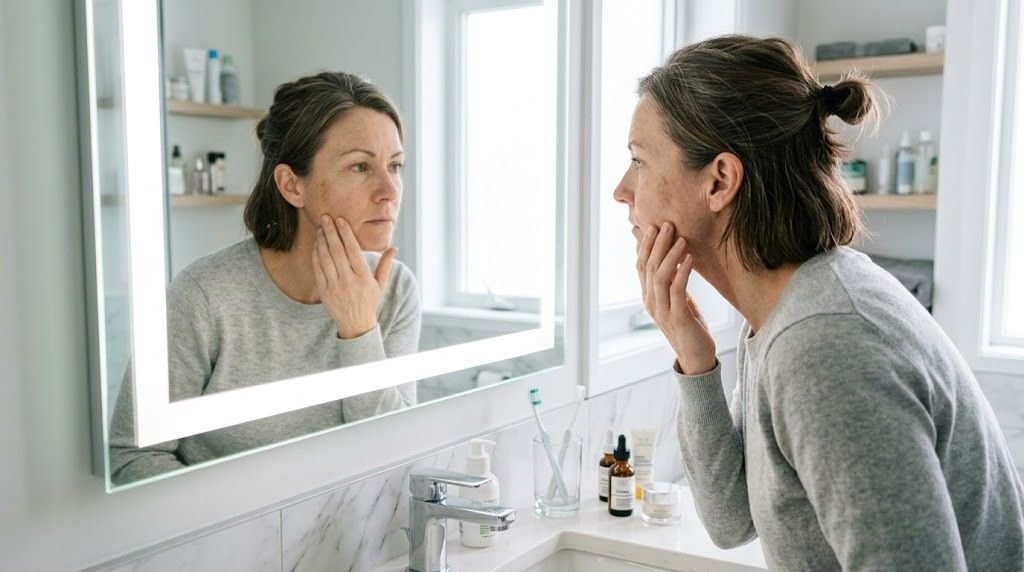
The goal here is sustainable, not perfect. A five-minute check you actually do every month beats a comprehensive audit you never get around to.
Setup. Do this in a bright room — natural light is ideal. You need a full-length mirror, a hand mirror, and your phone. Get undressed completely. I do mine after a shower on the first Sunday of the month; pick whatever you’ll remember.
Face and neck first. Examine your nose, lips, ears — and the backs of the ears, which most people miss entirely. Use the hand mirror for anything you can’t see straight on.
Scalp. Use a comb to part your hair in sections and move through methodically. This takes practice. If you have thick hair, a partner or your hairdresser is a useful second set of eyes.
Torso, front and back. The back is awkward — use your full-length mirror at an angle and the hand mirror together, or use your phone camera to photograph sections you can’t see directly. Don’t rush this. Your back is a large area with a lot of real estate you’ve probably never examined closely.
Arms, hands, and fingers. Include your palms and the spaces between your fingers. Check under your nails.
Lower body. Thighs, shins, tops and soles of feet, between your toes.
Document anything new or changed. One photo, noted in your app. You don’t need to annotate it extensively — just having the image is enough.
The whole thing runs about five to eight minutes once you know the sequence.
The Zones Women Miss Most
The ones nobody mentions: under your breasts, your genitals, between your toes, beneath your nails (a dark streak under a nail that you didn’t get from a door is a specific red flag), the back of your scalp along the part line, and the back of your neck under your hairline. Skin cancer doesn’t only show up where the sun hits directly.
→ Speaking of which: The Forgotten Zones — Skincare Spots You’re Probably Skipping
If you find something in one of these spots, assume the only reason it’s being seen now is because you looked. Get it checked.
When Should You Be Worried About a Mole? (Honest Answer)
Book an appointment — not eventually, now — if you notice any of these: a mole or spot that has grown rapidly over weeks rather than months; anything that bleeds without trauma; a sore or patch that won’t heal after four to six weeks; a new dark streak under a fingernail or toenail that you can’t explain; or any spot that itches, crusts, or oozes.
“Monitor and photograph” territory includes spots that are new but stable, marks that fit one ABCDE criterion but haven’t changed, and anything you’re uncertain about. When in doubt, photograph it and bring it to your next derm appointment — or call sooner if it changes before then.
Here is the thing that genuinely reframed how I think about this: 70 to 80% of melanomas develop on previously normal skin, not on existing moles. Which means mole-watching, while useful, is only part of the job. The whole point of skin checks for women over 40 is full-skin literacy. You’re not just tracking the moles you already know about. You’re looking at the whole surface.
That’s a bigger job, but it’s also a more useful one.
How Often Should Women Over 40 Get Professional Skin Checks?
Annually, starting at 40. Earlier if you have a family history of melanoma, a personal history of significant sun exposure or blistering sunburns, fair skin that burns easily, or a large number of moles.
A full-body skin exam with a dermatologist is not the same as your GP glancing at a spot during a physical. A proper check means you’re in a gown, in good light, and a trained set of eyes covers every surface — including the ones you struggle to see yourself. Some dermatologists use dermoscopy, a handheld magnifier that allows them to examine below the skin surface. It takes about fifteen minutes and is worth scheduling like it matters, because it does.
If your doctor hasn’t mentioned annual skin checks, you are allowed to ask for a referral. The sentence is: “I’m over 40 and I’d like to establish care with a dermatologist for annual skin exams.” That’s it. You don’t need a dramatic reason. Forty is reason enough.
SPF Isn’t Optional at This Point — Here’s What I’m Actually Using
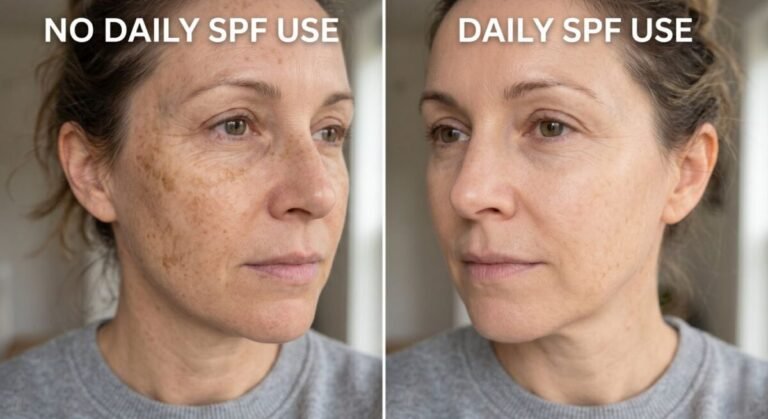
Daily SPF does two things at once, which I appreciate in a product: it reduces your future UV accumulation and it demonstrably slows visible skin aging. A study cited by the Skin Cancer Foundation found that consistent daily sunscreen use results in 24% less skin aging over time. You’re already using it for the anti-aging angle. The cancer prevention piece is the same bottle doing more work.
What I’ve been rotating through lately:
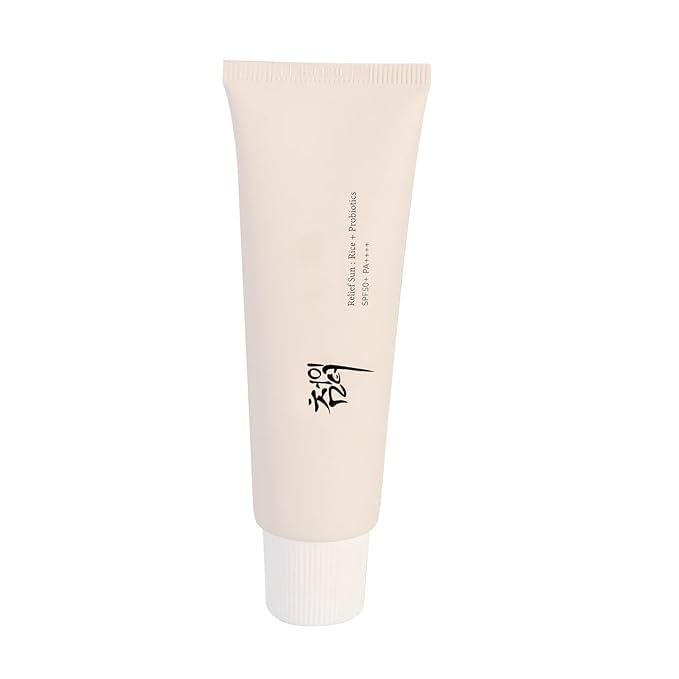
The Relief Sun Organic Korean Sunscreen SPF50+ gets recommended so often in skincare circles that I was initially suspicious, and then I tried it and understood the devotion completely. Light, slightly dewy finish, wears under makeup without pilling. If you’ve been avoiding SPF because of white cast or grease, this is the one that removes that excuse.
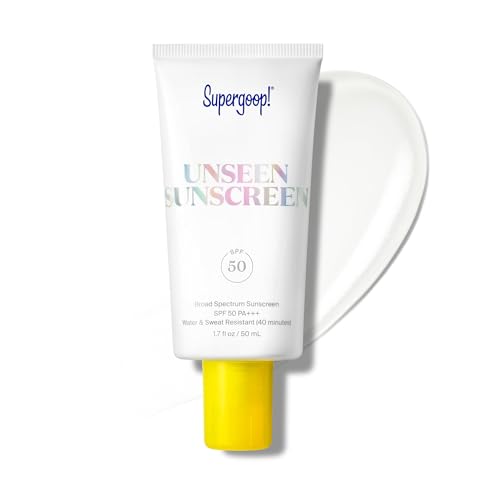
For days when I want truly invisible — no finish, no cast, nothing — the Supergoop! Unseen Sunscreen SPF 40 is exactly as advertised. It feels like a slightly silky nothing on the skin, which makes it ideal for layering over active ingredients without disrupting anything underneath.
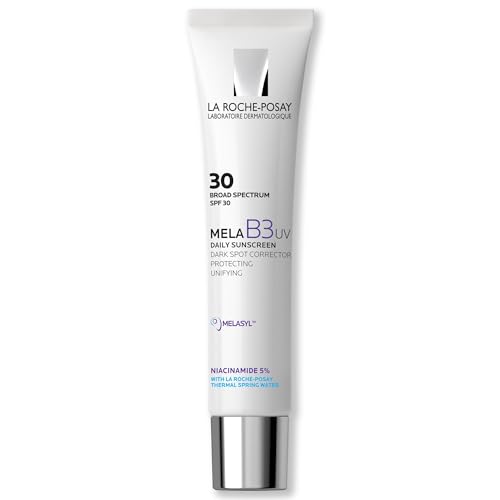
And when I want SPF built into my morning moisture without adding a step, the Mela B3 UV Daily Sunscreen Face Moisturizer SPF 30 earns its place. The niacinamide does real work on the uneven pigmentation that becomes more common after 40 — pulling double duty in a way I respect.
None of these are SPF 100. None of them need to be. A formula you’ll actually use every morning is worth more than a higher number sitting on your bathroom shelf.
The Whole Point
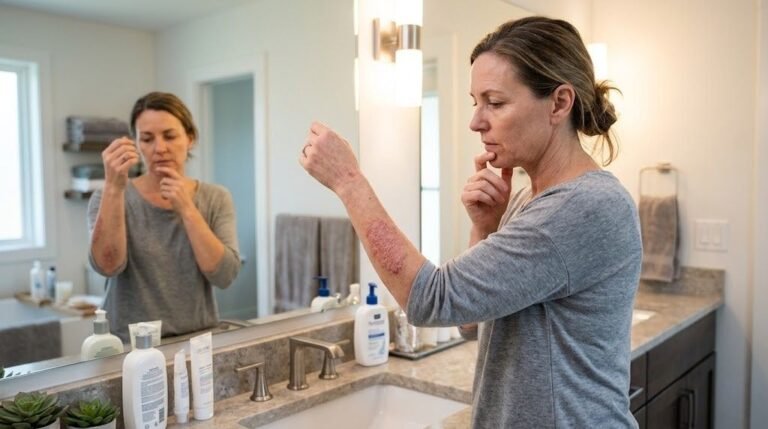
Skin checks are not a fear practice. They’re a knowledge practice. You already know your face — the lines that appeared in your late thirties, the spot on your left cheek that darkened two summers ago, the thing on your shoulder you’ve been meaning to ask about. You’re already doing informal surveillance. This is just making it intentional.
The woman who books her annual derm appointment, does her monthly check, and wears SPF every morning isn’t anxious. She’s informed. Those are different things, and one of them keeps you in the 99%.
Shop This Post
Discover more from The Harpy Nest
Subscribe to get the latest posts sent to your email.