
The Bare Minimum Skincare
This post contains affiliate links. If you buy through them, I may earn a small commission — at no extra cost to you.
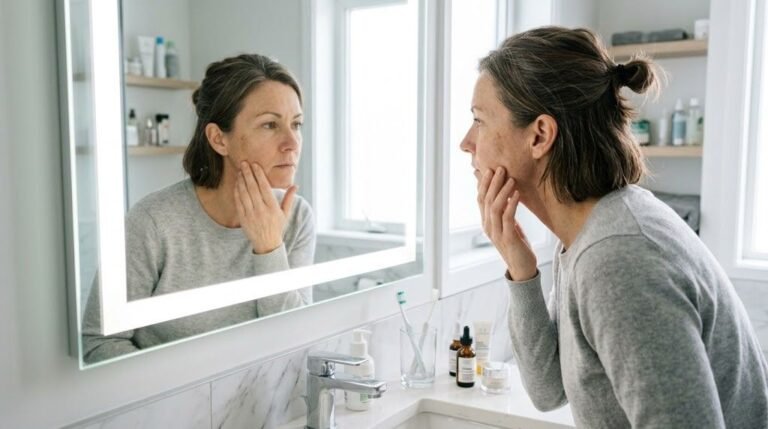
If you’ve been searching for the best moisturizer 40s can rely on, you’re probably noticing that the products you used in your 30s aren’t cutting it anymore. Your skin might feel tighter by midday, makeup looks cakey where it once glided on smoothly, and those fine lines around your eyes seem more pronounced than they did six months ago. These changes aren’t in your head. They’re the direct result of hormonal shifts that accelerate collagen loss, weaken your moisture barrier, and slow down cell turnover. The good news is that you don’t need a bathroom counter cluttered with ten different serums to fix it. A few well-chosen products, anchored by the right face cream for aging skin, can deliver visible results without the overwhelm or confusion. Sometimes the most effective skincare routine 40s women can adopt is also the simplest one.
Key Takeaways
- Hormones drive the changes: Estrogen decline in your 40s accelerates collagen loss, dryness, and barrier weakness, and your moisturizer needs to address all three.
- Less is more: A consistent 2-3 step routine outperforms an inconsistent 10-step one for mature skin.
- Ingredients matter more than price: Drugstore options with ceramides, hyaluronic acid, and peptides rival luxury products in clinical performance.
- Retinol is the one add-on worth it: If you do one extra step, dermatologists agree retinol delivers the most evidence-backed anti-aging results.
- SPF is non-negotiable: It’s the single most impactful anti-aging step regardless of how minimal your routine is.
- Your moisturizer should do triple duty: Look for formulas that hydrate (humectants), smooth (emollients), and seal in moisture (occlusives).
Why Moisturizer Matters More in Your 40s
The decade of your 40s marks a turning point for skin health. It’s not about vanity or chasing unrealistic beauty standards. It’s about understanding what’s happening beneath the surface so you can respond with the right tools. As perimenopause begins, often in the early-to-mid 40s, estrogen levels start to decline, triggering a cascade of changes that make moisturizer the most important product in your routine. This isn’t the same dry skin you might have experienced in winter during your 20s. It’s a fundamental shift in how your skin functions, and it requires a different approach.
The Estrogen-Collagen Connection
Estrogen plays a direct role in regulating collagen synthesis, the protein that keeps skin firm and plump. When estrogen drops, so does your skin’s ability to produce new collagen. Women can lose up to 30% of their skin’s collagen in the first five years after menopause, with collagen declining roughly 2% per year thereafter. This loss of collagen is what leads to sagging skin, deeper fine lines, and that crepey texture many women notice first on their hands and décolletage. Your skin also becomes thinner, literally losing volume and density. A great anti-aging moisturizer can’t replace collagen, but it can help your skin retain the moisture and structure it needs to look healthier and more resilient.
The Weakening Skin Barrier
Your skin barrier is made up of lipids, primarily ceramides, that act like mortar between the bricks of your skin cells. Ceramide levels naturally decline with age and estrogen loss, leading to what dermatologists call transepidermal water loss, or TEWL. This is when moisture evaporates from your skin faster than it can be replaced. The result is chronic dryness, tightness, increased sensitivity, and that uncomfortable feeling that no amount of water seems to fix from the inside. This is also why your skin may suddenly react to products it tolerated for years. A weakened barrier lets irritants in more easily. The right moisturizer for dry aging skin needs to contain ceramides to literally rebuild what your body is no longer producing in sufficient quantities.
Slower Cell Turnover
In your 20s, your skin cells turned over roughly every 28 days. By your 40s, that process can slow to 40-60 days or longer. Dead skin cells linger on the surface, creating a dull, rough texture and making it harder for your moisturizer to penetrate. This slowdown also means your skin takes longer to heal from irritation or damage. While a good moisturizer alone won’t speed up cell turnover the way retinol does, formulas with gentle exfoliating ingredients like niacinamide can help support a smoother, brighter complexion without stripping an already fragile barrier.
Warning Signs Your Moisturizer Isn’t Working
Sometimes the problem isn’t your skin. It’s that the lightweight gel moisturizer you’ve been loyal to since your 30s simply can’t keep up with what your skin needs now. Here are the red flags that it’s time to upgrade to a more supportive formula.
Sign A: Tightness and Dryness That Persists All Day
If your skin feels tight an hour after applying moisturizer, or if you find yourself reapplying multiple times throughout the day, your current product isn’t doing its job. This persistent dryness signals barrier dysfunction, not just mild dehydration. You need a formula with occlusives like dimethicone or petrolatum that physically seal moisture into your skin, not just humectants that draw water in and then let it evaporate.
Sign B: Fine Lines Looking More Pronounced
Dehydrated skin visually deepens fine lines, especially around the eyes, mouth, and forehead. This doesn’t mean your wrinkles are getting worse. It means your skin is so dry that every crease is more visible. Switching to a richer face cream for aging skin with hyaluronic acid and peptides can create immediate visible improvement because well-hydrated skin naturally plumps and smooths. Many women notice this effect within days of upgrading their moisturizer.
Sign C: Makeup Sitting Badly or Caking
If your foundation suddenly clings to dry patches or settles into lines it never used to, your skin is telling you it’s parched. Makeup application is one of the most reliable indicators of skin hydration. Dry, flaky mature skin disrupts even the best makeup. The fix is often as simple as using a more emollient moisturizer under your makeup and giving it a full five minutes to absorb before applying foundation.
Sign D: Increased Redness or Reactivity
A compromised moisture barrier makes skin more sensitive to everything, from weather to active ingredients to fragrances. If you’re noticing more redness, stinging, or irritation from products that never bothered you before, your barrier needs help. Fragrance-free moisturizers with ceramides and niacinamide are specifically designed to repair barrier function and calm reactive skin.
Choosing the Right Moisturizer: Key Indicators
Not all moisturizers are created equal, and the best moisturizer for women over 40 depends on your specific skin type and concerns. Here’s how to match your moisturizer to what your skin is telling you.
Indicator A: Very Dry or Flaky Skin
If your skin feels like sandpaper or you see visible flakes, you need a rich, occlusive cream. Look for formulas with ceramides, shea butter, and ingredients like petrolatum or dimethicone that sit on top of the skin and lock everything in. CeraVe Moisturizing Cream is the dermatologist favorite here because it combines ceramides 1, 3, and 6-II with hyaluronic acid and a non-greasy texture.
Indicator B: Combination or Oily Skin
Yes, oily skin in your 40s still needs moisturizer. Skipping it actually makes your skin produce more oil to compensate for dehydration. The key is choosing a lightweight, oil-free gel formula with hyaluronic acid that hydrates without clogging pores. Neutrogena Hydro Boost Water Gel is a budget-friendly option that absorbs quickly and works well under makeup.
Indicator C: Dullness and Uneven Tone
If your main concern is lackluster skin and hyperpigmentation, prioritize niacinamide and vitamin C in your moisturizer. Niacinamide brightens skin tone, minimizes pores, and reduces redness. Olay Regenerist Micro-Sculpting Cream is a cult classic that combines niacinamide with peptides and hyaluronic acid at a drugstore price point.
Indicator D: Loss of Firmness and Fine Lines
For visible signs of aging like sagging and wrinkles, look for peptide-rich formulas. Peptides are short chains of amino acids that signal your skin to produce more collagen. CeraVe Skin Renewing Cream Serum and La Roche-Posay Toleriane Double Repair both offer peptides alongside barrier-repairing ceramides, making them ideal for mature skin moisturizer needs.
Indicator E: Reactive or Perimenopausal Skin
If your skin has become unpredictable, stinging at random products or breaking out in rashes, you need a fragrance-free, minimal-ingredient formula. La Roche-Posay Toleriane Ultra is specifically designed for hypersensitive skin and focuses exclusively on barrier repair with zero potential irritants.
The Ingredients: What to Look For (and Avoid)
Understanding what’s on the label helps you make better decisions, especially when drugstore moisturizers often outperform luxury brands in clinical testing. Here’s what actually matters.
Must-Have Ingredients
Hyaluronic acid is a naturally occurring molecule that holds up to 1,000 times its weight in water. Your skin’s natural hyaluronic acid levels decline with age, making supplemental HA in skincare especially valuable. Look for formulas with multiple molecular weights because smaller molecules penetrate deeper while larger ones hydrate the surface.
Ceramides make up roughly 50% of your skin barrier and act like mortar between skin cells. As estrogen drops, ceramide production slows, leading to the dry, tight, sensitive skin many women notice in their 40s. Ceramide-based moisturizers directly replenish what the aging process depletes.
Peptides signal your skin to produce more collagen. Since collagen production is declining rapidly in this decade, peptides give your skin a nudge to compensate. They’re gentle enough for sensitive skin and pair well with all other actives.
Niacinamide (vitamin B3) is one of the most versatile ingredients for women over 40. It reduces inflammation, minimizes pores, helps even skin tone, and reinforces the barrier. It plays well with virtually every other ingredient, making it ideal for a minimalist skincare routine.
Glycerin is a reliable humectant that draws moisture into the skin without irritation. Squalane mimics your skin’s natural oils and absorbs beautifully. Shea butter provides fatty acids that reinforce the moisture barrier.
Ingredients Worth Adding
Retinol is the one active dermatologists most consistently recommend adding to the bare minimum skincare routine for women over 40. It increases cell turnover, boosts collagen, and visibly reduces fine lines. The key for this age group is starting low (0.025% to 0.1%) and applying it under moisturizer to buffer irritation. Retinoids are endorsed by the American Academy of Dermatology as one of the most evidence-backed over-the-counter anti-aging ingredients available.
Vitamin C in the morning neutralizes free radicals from UV and pollution, brightens hyperpigmentation, and boosts collagen alongside SPF. It’s the optional fourth step if you want to add one more product.
Ingredients to Avoid
Heavy fragrance can irritate already-sensitive skin and offers zero skincare benefit. Alcohol-based formulas strip the barrier. Daily physical exfoliants like scrubs can cause micro-tears in thinning skin. If a product lists “fragrance” or “parfum” high on the ingredient list, pass.
Moisturizer by Skin Type and Budget
You don’t need to spend a fortune to get results. Research consistently shows that drugstore moisturizers with the right ingredients perform as well as luxury options in clinical testing.
Dry and Very Dry Skin
Rich, cream-based formulas with ceramides and occlusives are your best bet. CeraVe Moisturizing Cream (around $17) and La Roche-Posay Toleriane Double Repair (around $25) are both dermatologist-recommended and perform beautifully for moisturizer for dry aging skin needs. If you want to splurge, Kiehl’s Ultra Facial Cream is formulated specifically to address lipid loss that accelerates in your 40s and 50s.
Oily and Combination Skin
Gel and fluid formulas hydrate without heaviness. Neutrogena Hydro Boost Water Gel (around $20) is a tried-and-true option. Many women in their 40s wrongly skip moisturizer thinking they don’t need it because their skin still produces oil. This is a mistake. Oily skin can still be dehydrated, and a lightweight moisturizer helps balance oil production.
Sensitive and Perimenopausal Skin
Fragrance-free, minimal-ingredient barrier repair formulas are critical when skin is reactive. La Roche-Posay Toleriane Ultra and First Aid Beauty Ultra Repair Cream are both excellent choices. Simplicity is especially important when your skin is unpredictable.
Budget vs. Splurge
CeraVe and La Roche-Posay consistently perform alongside $100+ options in clinical and consumer testing. The difference often comes down to texture, packaging, and marketing, not actual performance. A $17 drugstore moisturizer with ceramides, hyaluronic acid, and peptides will deliver the same results as a luxury cream with the same ingredients.
When and How to Apply for Best Results
Technique and timing can maximize what your best face moisturizer 40s skin needs can actually do for you.
Morning Routine Timing
Always apply moisturizer to slightly damp skin, ideally within 60 seconds of washing your face. Damp skin allows humectants like hyaluronic acid to pull moisture in more effectively. Follow immediately with broad-spectrum SPF 30 or higher. SPF is consistently ranked by dermatologists as the single most impactful anti-aging step, regardless of age.
Evening Routine Timing
Nighttime is your skin’s peak repair window. Your skin temperature rises slightly while you sleep, and cell turnover accelerates. A richer formula at night amplifies results. If you’re using retinol, apply it first to clean, dry skin, wait a few minutes, then layer your night cream over it to buffer potential irritation.
Application Technique
Press and pat your moisturizer into your skin rather than rubbing it in aggressively. Work outward from the center of your face. Don’t forget your neck and décolletage, which show aging just as visibly as your face. Use upward motions on your neck to avoid tugging delicate skin downward.
The Bare Minimum Routine: Step by Step
Here’s the simple skincare routine for women over 40 that dermatologists actually use themselves.
Step 1: Gentle Cleanser
A non-stripping, low-pH cleanser is the essential first step that sets up your moisturizer to work properly. Avoid foaming cleansers with sulfates, which strip natural oils. Look for cream or gel cleansers that leave your skin feeling clean but not tight. Micellar water is another gentle option, especially in the morning.
Step 2: Moisturizer
This is your workhorse product. Choose a formula based on your skin type and concerns using the guidance above. Apply to damp skin, morning and night. If you’re using a serum, apply it before your moisturizer.
Step 3: SPF (AM) or Retinol (PM)
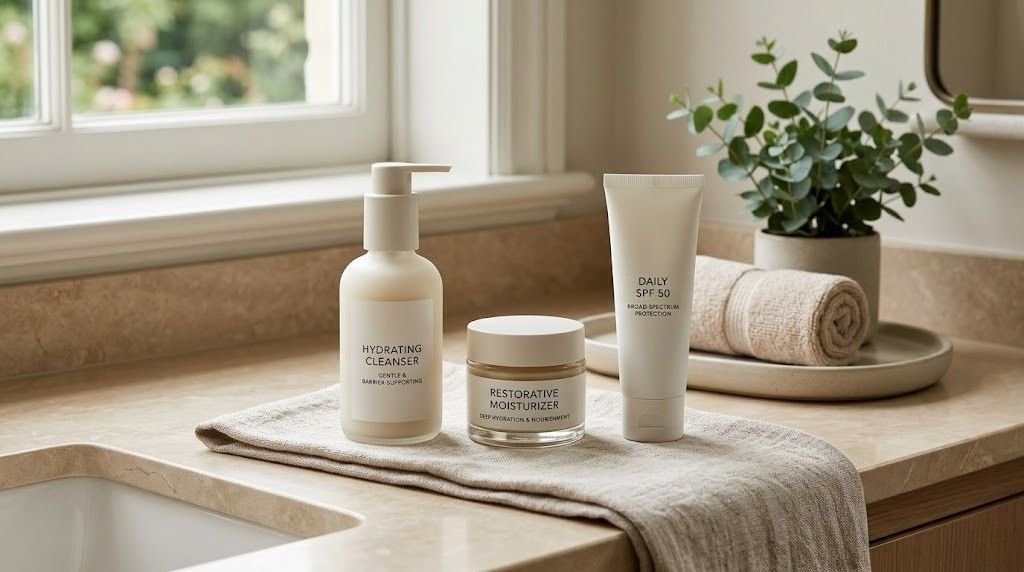
In the morning, SPF is non-negotiable. Look for broad-spectrum protection of at least SPF 30. Mineral sunscreens with zinc oxide or titanium dioxide are less irritating for sensitive mature skin. At night, retinol is the one active that delivers evidence-backed anti-aging results. Start 2-3 nights per week and increase gradually as your skin tolerates it. This combination of moisturizer, SPF, and retinol is what dermatologists recommend as the foundation of any anti-aging routine.
Long-Term Skin Strategy
Consistency with a minimalist anti-aging skincare routine prevents bigger concerns down the road and often outperforms complicated regimens.
Consistency Over Complexity
Sticking to the same 3 products for 12 weeks delivers more visible results than rotating between trending products every few weeks. Your skin needs time to respond to new ingredients. Give any new moisturizer at least 4-6 weeks for hydration benefits and up to 12 weeks to see meaningful changes in fine lines or texture. The concept of skinimalism for mature skin is grounded in this principle: fewer products, used consistently, work better than constant product switching.
Supporting Your Skin From the Inside
Hydration matters. Drinking enough water supports skin moisture from within. Omega-3 fatty acids from fish, flaxseed, or supplements help maintain skin elasticity. Collagen peptides taken orally may support skin thickness and hydration, though topical products remain the primary treatment. Sleep is also critical because skin repair accelerates during deep sleep cycles.
When to Upgrade or Adjust
Reassess your routine seasonally. You may need a richer moisturizer in winter and a lighter one in summer. If you’re entering menopause from perimenopause, your skin may become even drier and require more occlusive ingredients. If you notice significant texture shifts or increased sensitivity, it’s time to simplify further and focus on barrier repair.
Common Mistakes Women in Their 40s Make With Moisturizer
Avoiding these pitfalls can dramatically improve your results with the same products.
- Skipping moisturizer because skin feels oily: Oily skin can still be dehydrated, and skipping moisturizer often makes oil production worse.
- Using the same lightweight formula from their 20s: Your skin has fundamentally different needs now. A gel moisturizer that worked beautifully at 25 won’t cut it at 45.
- Layering too many actives and causing barrier damage: Multiple acids, retinol, and vitamin C all at once can overwhelm aging skin and trigger inflammation.
- Applying moisturizer to completely dry skin instead of damp: Damp skin allows humectants to work more effectively.
- Ignoring the neck and chest: These areas age visibly and need the same care as your face.
- Expecting overnight results and abandoning a routine too soon: Skincare for perimenopausal women requires patience. Give products at least a month.
- Choosing products based on scent or texture rather than ingredients: Beautiful packaging and lovely fragrance don’t repair your moisture barrier. Ceramides do.
How Moisturizer Fits Into Your Overall Skincare Strategy
Your moisturizer is the foundation that makes every other step work better. A well-hydrated, intact barrier tolerates actives like retinol more effectively, sees fewer side effects from vitamin C, and allows SPF to sit evenly without pilling or caking. When your barrier is strong, your skin looks healthier immediately because it reflects light better and holds onto the moisture it needs. The bare minimum skincare approach isn’t about settling or doing the least possible. It’s about being strategic. It’s about recognizing that skinimalism works because your skin in your 40s needs support, not stripping. Three great products used daily will always outperform ten mediocre products used inconsistently.
Frequently Asked Questions About best moisturizer 40s
Q: What is the best moisturizer for women in their 40s?
A: Dermatologists most consistently recommend formulas with ceramides, hyaluronic acid, and peptides. CeraVe Moisturizing Cream and La Roche-Posay Toleriane Double Repair are top-cited drugstore options. The best face cream women 40s can use is one that addresses barrier repair, hydration, and collagen support all at once.
Q: Do I really need a separate day and night moisturizer?
A: Not necessarily. A richer cream at night and a lighter SPF moisturizer in the morning is ideal, but one good moisturizer used consistently is far better than two products used sporadically. Many women find success using the same moisturizer twice daily and layering SPF over it in the morning.
Q: Is retinol safe to use in your 40s?
A: Yes. Retinol is one of the most evidence-backed anti-aging ingredients available and is appropriate for most women in their 40s. Start at a low concentration (0.025% to 0.05%) and apply it under your moisturizer to reduce irritation. If you’re new to retinol, begin with 2-3 nights per week.
Q: Can I use a moisturizer if I have oily skin in my 40s?
A: Absolutely. Oily skin still needs hydration, especially as the barrier weakens with age. Choose a lightweight, oil-free gel formula with hyaluronic acid rather than skipping moisturizer altogether. Skipping moisturizer can actually make your skin produce more oil to compensate for dehydration.
Q: What ingredients should I avoid in a moisturizer over 40?
A: Avoid heavy fragrance, alcohol-based formulas, and daily physical exfoliants like scrubs, which can all irritate and further weaken a mature skin barrier. If a product lists “fragrance” or “parfum” high on the ingredient list, it’s not ideal for sensitive or aging skin.
Q: How long does it take to see results from a new moisturizer?
A: Most dermatologists recommend giving any new product at least 4-6 weeks for hydration benefits and up to 12 weeks to see meaningful changes in fine lines or texture. Your skin needs time to respond, especially when you’re addressing barrier damage that has built up over time.
Final Thoughts
Your skin in your 40s isn’t broken. It’s changing, and it’s asking for something smarter, not more complicated. The minimalist skincare approach is about choosing a few powerhouse products and using them consistently, with a great moisturizer as the non-negotiable core. Whether you spend $17 on CeraVe or $150 on a luxury cream, the ingredients are what matter. Ceramides, hyaluronic acid, peptides, and niacinamide will deliver visible results regardless of the price tag on the jar.
Starting with the right moisturizer, adding SPF every morning, and giving retinol a try at night creates a foundation that your skin will respond to. You’ll see fewer fine lines, better hydration, improved texture, and a healthier glow that comes from a strong, resilient moisture barrier. The long-term value of this approach is that it’s sustainable. You’re not chasing trends or spending hours in front of the mirror. You’re giving your skin exactly what it needs, nothing more and nothing less.
Discover more from The Harpy Nest
Subscribe to get the latest posts sent to your email.